

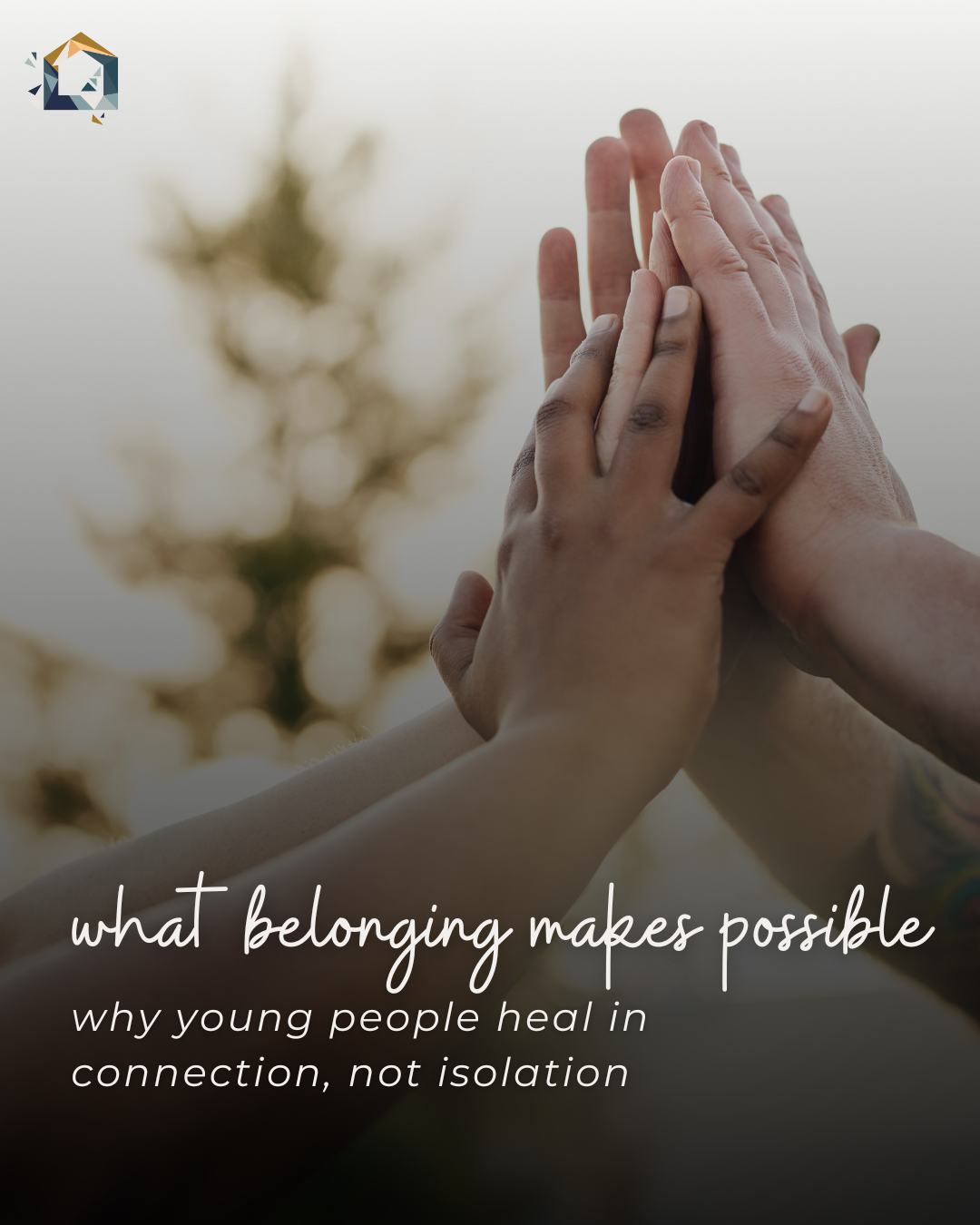
Belonging is often talked about like a feeling — something nice when it’s present and unfortunate when it’s not.
But the research tells a different story.
Belonging is a basic human need, and for many of the young people and families we serve at Cathedral Home, it may be one of the most important conditions for healing, growth, and wellbeing.
Belonging is a need, not a nicety
For years, belonging was treated as something secondary. A bonus. A soft skill.
The science says otherwise.
In a foundational 1995 paper, psychologists Roy Baumeister and Mark Leary argued that the need to belong is a fundamental human motivation, as essential to wellbeing as safety and connection. Since then, decades of research have linked low belonging to poorer mental and physical health outcomes, while strong relationships and supportive communities are associated with resilience, stability, and growth.
That matters because mental health is about more than the absence of crisis.
A young person can be surviving and still not feel connected.
They can be functioning and still not feel known.
Wellbeing is something we build over time through relationships, trust, safety, skill, and connection. Belonging creates the conditions where that growth becomes possible.
For young people especially, belonging can feel fragile. Adolescence often means navigating changing friendships, identities, expectations, and environments while trying to figure out where you fit and who you are becoming.
The need for belonging stays constant.
The experience of it often does not.
Belonging is Built
One of the most hopeful insights from recent research is that belonging is not fixed.
In their 2024 book Belonging without Othering, john a. powell and Stephen Menendian describe belonging as something shaped by everyday experiences, relationships, and environments. A young person may feel accepted and connected in one place and isolated in another, sometimes within the same day.
That reality is both sobering and hopeful.
It reminds us how easily young people can begin to feel unseen or disconnected. But it also reminds us that belonging is something communities can actively create.
A welcome.
A trusted adult.
A coach who keeps showing up.
A counselor who remembers what mattered last week.
A place where someone feels safe enough to tell the truth.
Those moments matter more than we sometimes realize.
powell and Menendian also describe the deeper pattern that interrupts belonging: othering, the tendency to divide people into “us” and “them.”
At Cathedral Home, we try to hold onto a different belief:
Every young person already belongs here.
Not because they have everything figured out.
Not because they have earned care or support.
But because every child deserves connection, safety, and someone willing to stay alongside them.
What lived experience adds to the science
Research helps explain why belonging matters. Lived experience helps us understand what it feels like when it is missing — and what becomes possible when it is restored.
Gaelin Elmore, who spent more than a decade in foster care before eventually playing in the NFL, often speaks about the role belonging played in changing the direction of his life. Not achievement alone. Not talent alone. Relationships. Consistency. People who made room for him and stayed.
Today, Elmore works with organizations to help them become more belonging-informed, particularly when supporting young people who have experienced trauma, instability, or loss.
One of his most important reminders is this:
Young people who have been hurt do not automatically owe adults their trust.
Trust is built slowly.
Belonging is offered first.
That perspective changes the question from:
“What is wrong with this young person?”
to:
“What does this young person need in order to feel safe enough to grow?”
That shift matters.
Because healing rarely happens in isolation. Young people grow through relationships, environments, and communities that help them feel seen, supported, and valued.
What this means for the young people we serve
For more than a century, Cathedral Home has walked alongside young people and families across Wyoming. Programs and services have evolved over the years, but the through-line has remained the same:
Healing happens in connection.
In residential treatment, belonging looks like consistent adults who continue showing up so that safety begins to feel reliable instead of rare.
In outpatient counseling, it looks like a steady relationship where a young person feels genuinely known over time.
In crisis services, it looks like meeting families in difficult moments without judgment, helping them feel supported instead of alone.
In prevention and family support work, it looks like strengthening the network of people around a young person long before a crisis ever takes shape.
None of this is extra to the work.
It is the work.
The science of belonging and the lived experience behind it point to the same conclusion:
Young people heal in connection, not isolation.
And communities play an important role in creating those conditions.
All kids are our kids
It can be easy to think about struggling young people as someone else’s responsibility. Someone else’s child. Someone else’s problem to solve.
But belonging asks something different of us.
It asks us to widen the circle.
To see young people not as problems to manage, but as members of a shared community who deserve care, opportunity, safety, and support.
At Cathedral Home, we believe every child deserves someone to turn to. Creating that kind of community takes all of us — parents, teachers, coaches, neighbors, employers, donors, volunteers, and trusted adults willing to keep showing up.
Belonging does not happen by accident.
It is built through relationships.
Through consistency.
Through communities that decide no young person should have to navigate hardship alone.
That is work worth doing together.
Sources and Further Reading
Roy F. Baumeister and Mark R. Leary, “The Need to Belong: Desire for Interpersonal Attachments as a Fundamental Human Motivation,” Psychological Bulletin (1995)
john a. powell and Stephen Menendian, Belonging without Othering: How We Save Ourselves and the World (Stanford University Press, 2024)
Gaelin Elmore, speaker and facilitator on belonging-informed practice and the 4 Directions of Belonging